
Selected workCase study
E-CommerceMulti-Vendor Marketplace
Ramlogics Marketplace: Multi-Vendor E-Commerce
A multi-vendor marketplace where independent sellers share one storefront and one checkout, with automatic commission, vendor dashboards and a single admin panel.

The project
A clear idea, shaped into a useful product experience.
A multi-vendor marketplace where independent sellers share one storefront and one checkout, with automatic commission, vendor dashboards and a single admin panel.
Ramlogics Marketplace is a multi-vendor e-commerce marketplace for India, engineered as a fully working demo build. Independent vendors list and sell on one shared storefront, customers pay in a single checkout, and the owner earns an adjustable 10% commission on every order. It supports INR pricing, Razorpay (UPI, cards, net banking) and Cash on Delivery.
Three roles power the marketplace
- Admin: one owner controls the whole marketplace.
- Vendors: sellers register, add products, and manage orders and earnings.
- Customers: browse, pay and track orders; anyone can register.
A full shopping journey for customers
The homepage has a sale countdown, daily deals, a hero carousel and category tiles. Product pages carry trust badges, search, cart, coupons and a three-step progress bar. Checkout runs through Razorpay or Cash on Delivery and ends on a thank-you page with the order number, and accounts offer order tracking and saved addresses on every device.
Vendors self-serve from their own dashboard
Sellers register through the Become a Seller page and get a personal store page. Their dashboard shows sales, orders and earnings; they add, edit and delete products, update order status and request withdrawals from Rs 100. A public store listing shows all vendors.
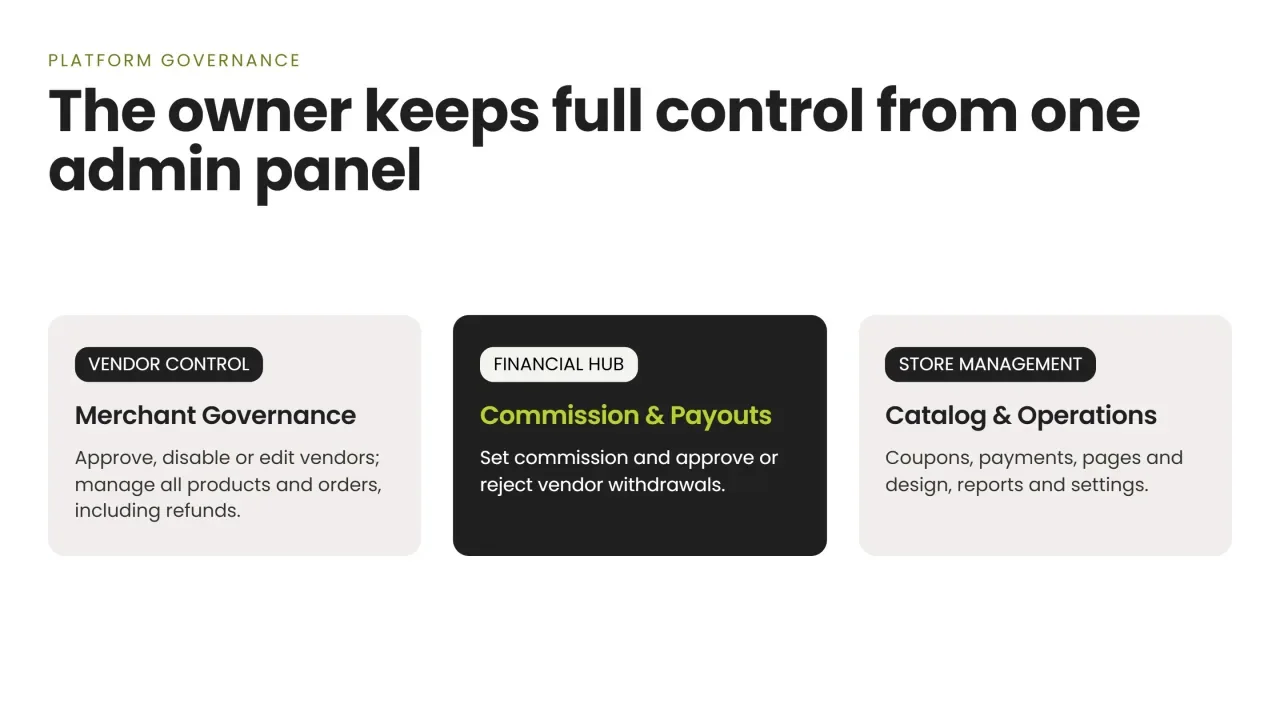
The owner keeps full control
One admin panel covers merchant governance (approve, disable or edit vendors, manage all products and orders including refunds), the financial hub (set commission, approve or reject withdrawals) and store management (coupons, payments, pages and design, reports and settings). A verified test order split the sale 10% to the owner and 90% to the vendor automatically.
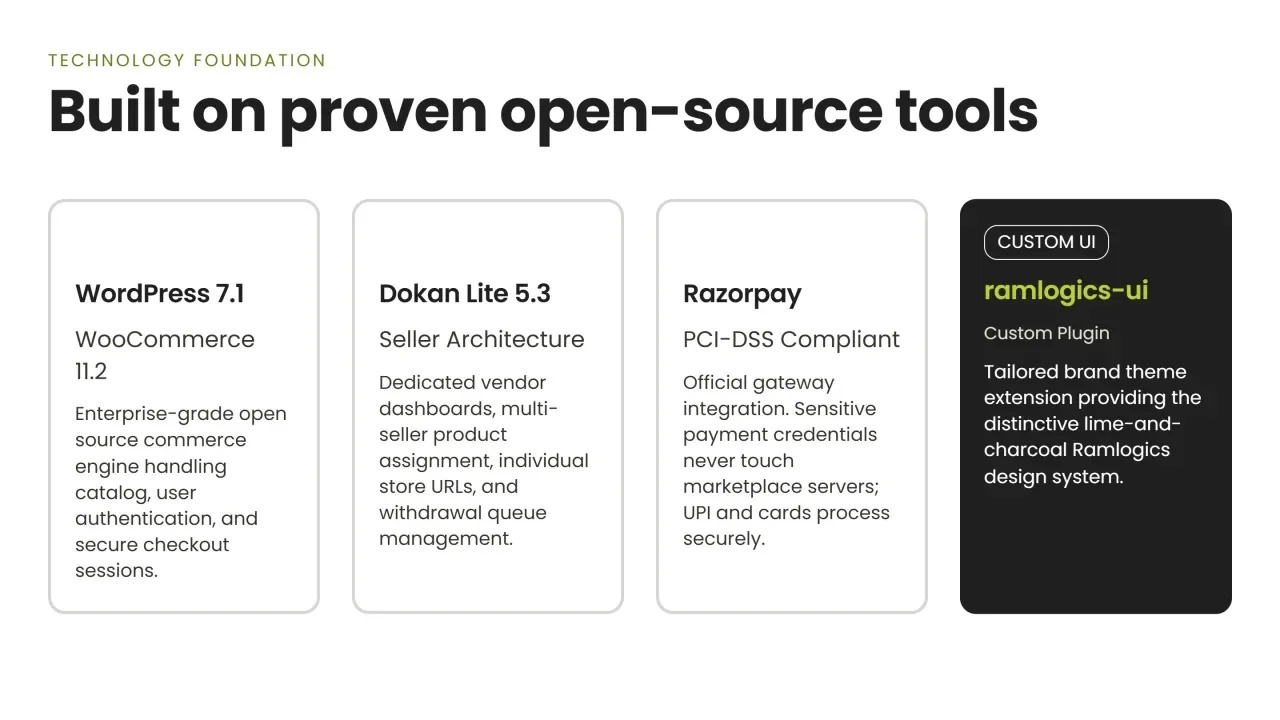
Technology foundation
- Core engine: WordPress 7.1 and WooCommerce 11.2 for catalogue, authentication and secure checkout sessions.
- Multi-vendor: Dokan Lite 5.3 for vendor dashboards, multi-seller product assignment, individual store URLs and the withdrawal queue.
- Payments: the official Razorpay gateway (PCI-DSS compliant); sensitive payment credentials never touch marketplace servers.
- Custom UI: the ramlogics-ui plugin delivering the lime-and-charcoal Ramlogics design system.
Demo catalogue and launch steps
The demo is loaded with 926 products, 95 vendors and 6 categories (Electronics, Fashion, Home & Kitchen, Beauty, Grocery and Toys) as sample data, to be replaced with real vendors before launch. The buyer, vendor and admin flows work; live Razorpay keys after KYC, hosting, domain and SSL, real vendors and products, SMTP order emails, shipping and GST, and policy pages complete the launch.
Inside the case study
Selected pages from the full PDF. Click an image to enlarge it, or open the complete document with the button above.


Understanding the context
The product starts with a situation worth making simpler.
A multi-vendor marketplace where independent sellers share one storefront and one checkout, with automatic commission, vendor dashboards and a single admin panel.
Three roles
One admin, many vendors and customers who can register themselves
Vendor self-service
A personal store page and a dashboard for sales, orders and earnings
Full customer journey
Sale countdown, daily deals, coupons, Razorpay or Cash on Delivery and order tracking
How the work is framed
From a real need to a considered product direction.
This story follows the evidence available in the project brief. It separates the problem, the product decisions, the documented flow, and the final interface so the work is easy to review.
Understand the context
A multi-vendor marketplace where independent sellers share one storefront and one checkout, with automatic commission, vendor dashboards and a single admin panel.
Define the opportunity
The brief identifies the product need and the constraints that shape the experience.
Shape the solution
The documented feature set provides the product direction.
Review the result
The flow, interface documentation, and live product link make the proposed experience tangible and reviewable.
Product lenses
The people and moments this experience is designed to support.
Three roles
One admin, many vendors and customers who can register themselves
Design focus Make this part of the journey clear, useful, and easy to return to.Vendor self-service
A personal store page and a dashboard for sales, orders and earnings
Design focus Make this part of the journey clear, useful, and easy to return to.Full customer journey
Sale countdown, daily deals, coupons, Razorpay or Cash on Delivery and order tracking
Design focus Make this part of the journey clear, useful, and easy to return to.Automatic commission
Adjustable rate, with a verified test order split 10% owner and 90% vendor
Design focus Make this part of the journey clear, useful, and easy to return to.Vendor payouts
Withdrawals from Rs 100, approved or rejected by the admin
Design focus Make this part of the journey clear, useful, and easy to return to.Owner governance
Approve vendors, manage products and orders including refunds, coupons and reports
Design focus Make this part of the journey clear, useful, and easy to return to.Selected interface story
Three views that explain the product without making visitors browse a document archive.
The brief is edited into a short visual narrative: what the product is, how the main experience is organised, and what the documented scope includes.
In the browser
Explore the product experience.
Load the live product previewThe preview loads only when you open it. Some product sites may restrict embedding.
If the embedded preview is unavailable, open the product in a new tab using the link above.
Product direction
The capabilities that shape the experience.
Three roles
One admin, many vendors and customers who can register themselves
Vendor self-service
A personal store page and a dashboard for sales, orders and earnings
Full customer journey
Sale countdown, daily deals, coupons, Razorpay or Cash on Delivery and order tracking
Automatic commission
Adjustable rate, with a verified test order split 10% owner and 90% vendor
Vendor payouts
Withdrawals from Rs 100, approved or rejected by the admin
Owner governance
Approve vendors, manage products and orders including refunds, coupons and reports
The product language
A system that keeps the experience coherent as it grows.
The case-study record is used as the source of truth for the product direction. The interface, flow, and documentation stay connected to the same scope instead of presenting isolated screens.
Documented technology
- WordPress · WooCommerce · Dokan · Razorpay
Boundary: Working demo
Conclusion and design notes
What the documented product covers.
Technology
- WordPress · WooCommerce · Dokan · Razorpay
Documented status: Working demo
Have a product idea?
Let’s make the next one yours.
Tell us what you are building and we’ll help plan a practical next step.